

Looking for your first job in tech? You’re not the only one.
It’s competitive out there
When we post for co-op positions, we typically receive 30 – 70 resumes per academic institution. When we post for full-time positions, that number jumps to around 200+. And we’re just a small IT company, so imagine how many applicants a larger tech company would receive. I don’t write this to discourage you, dear reader, but to emphasize the importance of crafting an impactful resume. Applying for jobs is not simply a numbers game – if you apply to 100 positions with a poor resume, expect zero replies.
This article includes my advice on what content to include/exclude on your resume for your first entry-level position. These are not objective rules that all hiring managers will agree with. My recommendations are based on manually poring over countless tech resumes for the past 5+ years. These are my suggestions to catch the eye of a real-life human. EMKAL is still willfully in the stone ages of manually reviewing resumes. If someone took the time to apply for a position at EMKAL, they deserve to have their resume read. Look elsewhere if you want advice on how to squeak past an AI resume screening tool.
Do I need a cover letter?
Yes. There are a few reasons for this.
Firstly, I want to see your written communication, which is a necessary skill at a Managed Service Provider (MSP) such as EMKAL. Grammar is important, but I’m more interested in gaining some insight into how you present yourself. For example, it’s not compelling if you mainly focus on how you will benefit from working here. Good cover letters indicate how the organization would benefit by having you on their team.
Secondly, I look for customization. I barely skim copy-pasted cover letters that are clearly going out to every employer. What is it about our specific organization that resonates with you? Check the “about us” section, blogs, LinkedIn posts, testimonials, online reviews, charity work, etc. Find something that is meaningful and connect it to yourself. If you can’t find any connection between yourself and the company, then you’re making it difficult for the hiring manager to envision how you would be a good fit.
Thirdly, it’s just standard protocol to include a cover letter with an application. Working for an MSP, you will be asked to read, understand, and follow protocol over and over again. If my first impression of you is that you eschew protocol, you’re starting at a disadvantage.
Last point about your cover letter: one page. That’s it. If it spills over, it signals that you may struggle with being clear and concise. And again, it goes back to protocol: one page is the expectation.
Resume length
Again, one page. Less is more. You have a few minutes of a hiring manager’s time, make them count.
Resume section: technical skills
I don’t know when or how this trend started, but far too often I see candidates include this section and list dozens of technologies such as JavaScript, Linux, Visual Studio Code, etc. At best I skim for familiar terms, but usually my eyes just dart to the next section. You’re either in co-op or just out of school, so realistically how deep can your knowledge be across all of these technologies? More importantly, the job posting does not ask for any of these skills, so it’s frankly not helpful in making a decision about you, it just takes up valuable real estate. I recommend either tailoring this section to just a few key technologies that are listed or implied by the job posting, or just removing this section entirely.

You’re not going to read all of these, and neither am I.
Resume section: student projects
This is another section I tend to skip. These projects were part of your program; you were expected to do them in order to graduate. This does not differentiate you from other applicants. I especially avoid reading about group projects: I’m not hiring your group, I want to know what you can do.
The only exception is if you have your individual project live and accessible on the internet. I would take a few minutes to review what you produced, but note that this cuts both ways: if your output is unimpressive or buggy, it will count against you.
I find that the student project section often takes up a third or even half a page of the resume. It’s not a good use of the limited space and attention of the hiring manager.
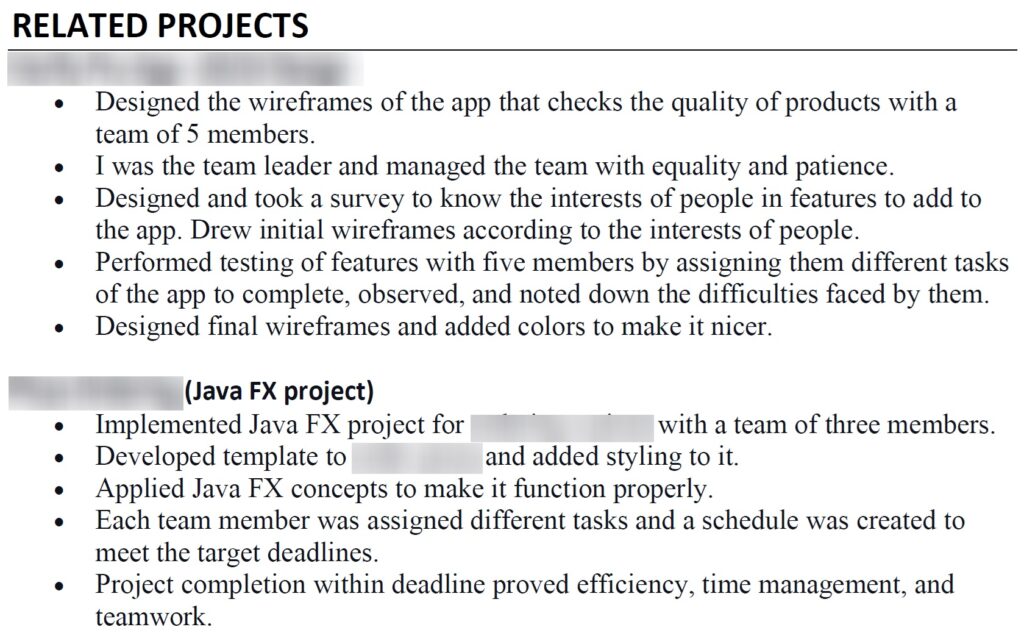
So, how will this experience make you an excellent helpdesk technician?
Resume section: interests
Based on how critical I have been of the two resume sections above, you might expect that I would also be critical of something “fluffy” like interests. However, I am a fan of this section. I like to see a balance of leisure activities (photography, tennis, improv, whatever floats your boat) with professional interests.
What kinds of professional interests? Preparing for a certification such as CCNA or Security+ is not an interest, and furthermore is not a strong point on your resume. I see a lot of resumes of people planning to get these certs, but very few that can claim actual completion.
The great thing about tech is that there are very few barriers to gaining real-world experience. Not at a job, but on your own time because you are legitimately interested in your field. This might be surprising, but some people stumble into a tech education because they think it will lead to a lucrative career, not because they actually care about it. We only want to hire people who care about tech as much as we do, and I strongly doubt that we’re the only company that holds this sentiment.
How do we dabble in tech? One of our recent successful hires builds his own drones. It was one of the reasons we interviewed him, and he’s developing into a good tech. Another one of our successful hires created his own server and set up an IoT network in his house. And guess what? He’s great at his job too. One member of our team was the go-to IT guy for his friends and family and has built countless computers. Today he’s our Operations Manager.
So, dear reader, how do you dabble in tech? Do you tool around with an Arduino breadboard? Perhaps you prefer challenges such as Advent of Code, Advent of SQL, or Advent of Cyber? Maybe you participated in the Huntress Capture the Flag event? Have you completed any simple video games just for the fun of it? Are you more hands-on and belong to a Maker Space community? There’s no right answer here, but if you are applying for a tech position, I strongly recommend that you have something like this in your resume. It’s often said that a resume should convey passion. Passion isn’t in your words about how super excited you are to work at a company, it’s in your actions.

It’s not just a drone, it’s hands-on troubleshooting, systems thinking, and continuous learning.
Conclusion
Ultimately, a solid resume effectively conveys why you would be an excellent fit for the company and the position. Information that does not fit this narrative should be scrapped. You are fighting an uphill battle if you do not have similar relevant experience, sure, but you can supplement with legitimate interests that intersect with your desired career path and indicate a thirst for learning and development. Demonstrating curiosity, a willingness to improve, and a growth mindset in the real world go a long way, especially when you’re looking for your first entry level position. Craft your resume in such a way that it will make the hiring manager say, “I want to interview the candidate who <insert cool tech stuff here>”.